
By Katlyne Brutus, MSN, FNP-C, PMHNP-BC | Clearview Behavioral Health and Wellness Services
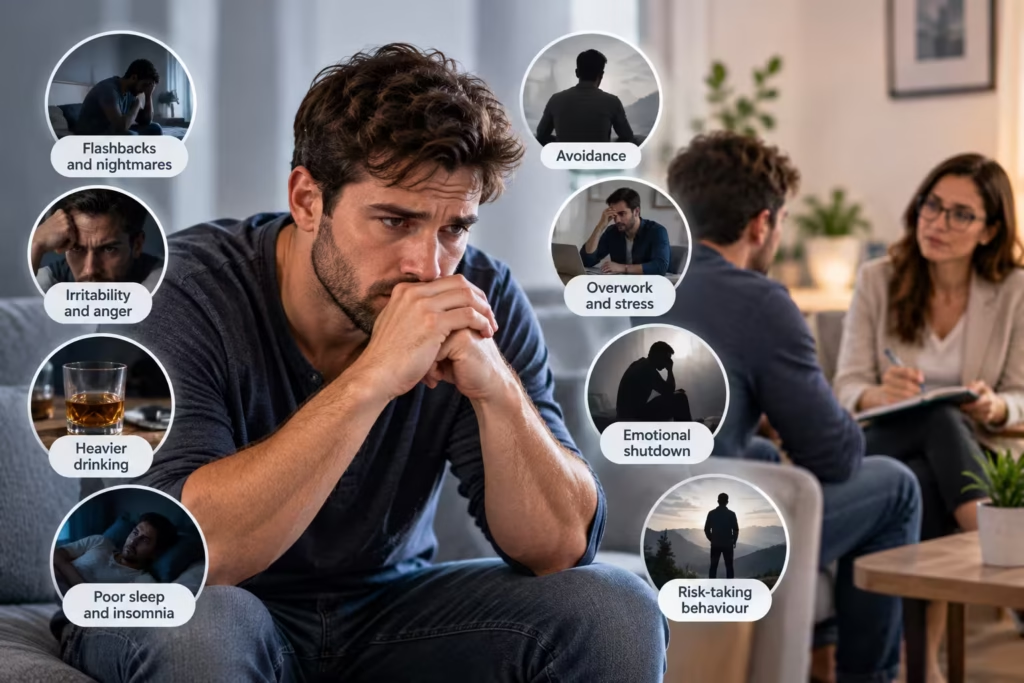
PTSD symptoms in men follow the same diagnostic criteria as in anyone else, but they often surface as irritability, anger, heavier drinking, overwork, reckless choices, broken sleep and physical complaints rather than visible fear or sadness. That outward pattern is a big reason PTSD in men goes unrecognized. The man himself, his family and sometimes his clinicians read it as a short temper, a drinking problem or job stress, and the trauma underneath never gets named. National survey data show men report traumatic events more often than women, yet are diagnosed with PTSD about half as often. If changes in mood, sleep, temper or behavior started or got worse after a frightening or violent event and have lasted longer than a month, a proper evaluation is worth getting. PTSD is treatable, and trauma-focused therapy has the strongest evidence.
| Key takeaways
• PTSD has four symptom clusters: intrusion, avoidance, negative changes in thinking and mood, and changes in arousal and reactivity. In my practice, the last two are often the most visible in men. • Anger, emotional shutdown, alcohol use, workaholism, risk-taking, insomnia, pain and sexual problems are common ways PTSD looks in men. • It gets missed because of masculinity norms, because men tend to describe body symptoms instead of emotions, and because the anger or drinking gets treated as the whole problem. • Women have higher lifetime PTSD rates (about 8% vs. 4%, per the VA), but men are more often exposed to trauma. • About 6% of male veterans will have PTSD in their lifetime, with higher rates among Iraq, Afghanistan and Gulf War veterans. • Short screens such as the PC-PTSD-5 and PCL-5 can flag it. A clinician confirms the diagnosis. • The 2023 VA/DoD guideline puts trauma-focused therapy (CPT, PE, EMDR) first. Sertraline, paroxetine and venlafaxine are the recommended medications. |
What PTSD is: the four DSM-5-TR symptom clusters
Post-traumatic stress disorder can develop after a person is exposed to actual or threatened death, serious injury or sexual violence. The exposure can be direct, witnessed, learned about when it happened to someone close, or built up through repeated contact with the gruesome details of other people’s trauma, which is how many police officers, firefighters, paramedics and medics are affected. The VA National Center for PTSD summary of the DSM-5 criteria lays these out, and notes that the 2022 DSM-5-TR did not change the adult PTSD criteria.
You may see lists of “17 symptoms of PTSD” online; that count comes from the older DSM-IV criteria. The DSM-5-TR lists 20 symptoms across four clusters, and a diagnosis needs symptoms from each:
- Intrusion (Criterion B, at least 1): unwanted memories, nightmares, flashbacks, distress or physical reactions to reminders.
- Avoidance (Criterion C, at least 1): steering clear of trauma-related thoughts, feelings, people, places or situations.
- Negative changes in cognition and mood (Criterion D, at least 2): harsh beliefs about yourself or the world, blame, persistent negative emotion, lost interest, feeling cut off from people, trouble feeling positive emotions.
- Arousal and reactivity (Criterion E, at least 2): irritability or aggression, reckless or self-destructive behavior, hypervigilance, a strong startle, poor concentration, poor sleep.
Symptoms must last more than one month, cause real distress or impairment, and not be better explained by a substance or medical condition. According to the National Institute of Mental Health, symptoms usually begin within three months of the event, though sometimes later. Others feel fine at first and only begin struggling months or years afterward, often after a new stressor such as retirement, divorce, an anniversary or a second trauma. When full criteria are met only six months or more after the event, the DSM calls it delayed expression. A decades-old trauma can still be the source of current symptoms.
PTSD symptoms in men, cluster by cluster
When I assess men for trauma, the opening line is rarely about flashbacks. It is more often about snapping at people, not sleeping, or a partner saying he has changed. The symptoms are the textbook ones, arriving in a different order and under different labels.
| Official symptom cluster | How it can look in men | What it often gets mistaken for |
| Intrusion | Nightmares, waking drenched in sweat, a racing heart or anger surge after a sound, smell or news story; replaying the event while driving or at work | “Bad dreams,” a heart problem, “stress” |
| Avoidance | Refusing to talk about a deployment, crash or assault; skipping crowds, certain roads or family events; filling every hour so there is no quiet time to think | Being private, being busy, “just not a social guy” |
| Negative changes in cognition and mood | Emotional numbness, seeming flat or distant with a partner and kids, guilt or blame, cynicism (“people can’t be trusted”), losing interest in hobbies, sex or friends | Depression alone, burnout, midlife crisis, a marriage problem |
| Arousal and reactivity | Irritability, rage, road rage, punching walls, sitting with his back to the wall, checking locks, reckless driving, heavy drinking, gambling or fights, insomnia, poor focus | An “anger problem,” alcohol use disorder, ADHD, a personality issue |
Anger, irritability and aggression
Irritability and aggressive outbursts are listed in Criterion E for a reason. A nervous system stuck in threat mode treats ordinary frustrations (a slow driver, a child’s noise, a coworker’s comment) as if they were danger. Many men experience this as anger because anger feels more acceptable to them than fear. Partners often describe a fuse that got much shorter after a specific event. That timing detail matters a great deal clinically.
Emotional numbing and withdrawal from family
Numbing is one of the most painful symptoms for families and one of the least recognized. A man may be physically home and emotionally absent. He may stop hugging his kids, avoid conversations that go below the surface, or say he “doesn’t feel much of anything.” This is a symptom, not a lack of love, and it often improves with treatment.
Alcohol, drugs and other ways of managing it
Drinking to fall asleep, to quiet the replaying or to take the edge off being on guard is common. A review in the NIAAA journal Alcohol Research: Current Reviews by Allen, Crawford and Kudler notes that alcohol abuse or dependence was the psychiatric condition most likely to co-occur among men with PTSD, and, according to VA program data cited in the review, 26.5% of VA patients with PTSD in fiscal year 2013 also had a substance use disorder. The drinking needs its own attention, and treating it alone usually leaves the nightmares and the constant scanning for danger in place.
Overwork, risk-taking and staying busy
Some men avoid by doing. Sixty-hour work weeks, constant projects and never sitting still keep intrusive thoughts at bay. Others chase intensity through speeding, fights or risky bets, which fits the “reckless or self-destructive behavior” item in Criterion E. From the outside these look like personality traits. In an evaluation, I ask when they started.
Sleep problems and nightmares
In my experience, trouble falling or staying asleep and trauma-related nightmares are among the most common reasons men with PTSD first see any clinician. Many men will talk about sleep long before they will talk about trauma, which makes the sleep complaint an important doorway.
Physical symptoms of PTSD in men
Chronic tension, back and neck pain, headaches, stomach and bowel trouble, fatigue, and a pounding heart under stress are frequent complaints. Some of this reflects a body that stays braced for danger. Some reflects poor sleep and alcohol. They deserve a medical workup and the question, “Did anything happen before this started?”
Sexual and relationship changes
Low desire, trouble with arousal, avoiding intimacy, or the opposite pattern of using sex to shut down distressing thoughts can all appear. SSRIs used for PTSD can also affect sexual function, so it helps to sort out timing with your prescriber. Relationship strain is often the thing that finally brings a man in, usually because a partner asked him to come.
Why PTSD in men is often missed
Masculinity norms and stigma
Many men are raised, coached or trained to stay in control, not complain and handle things alone. Those habits can be useful under pressure and harmful afterward. A 2020 systematic review by Neilson and colleagues in Psychology of Men & Masculinities, covering 17 studies and more than 3,500 veterans, found that strict adherence to traditional masculine norms was associated with more severe PTSD symptoms, with the strongest link to the belief that emotions must be controlled. As the American Psychological Association’s summary of the review notes, the authors also pointed to reduced help-seeking. Avoiding emotion keeps PTSD going, so stoicism can deepen the problem it is meant to manage.
Men describe body symptoms instead of feelings
In primary care and in my own evaluations, men are more likely to lead with insomnia, pain, fatigue, stomach trouble or “stress” than with fear, sadness or shame. If nobody asks about trauma, the visit ends with a sleep aid or a referral for the back, and the pattern continues.
The diagnosis gets pinned to the wrong problem
When anger or alcohol is the most visible symptom, it can become the only thing treated. A man may be sent to anger management or a detox program while the nightmares, hypervigilance and numbing go unexamined. A qualitative study of male veterans who had experienced military sexual trauma, Elder and colleagues in Psychology of Men & Masculinity (2017), argued that some behaviors labeled as “acting out,” such as appearing tough or using sex to avoid painful thoughts, are more accurately understood as trauma-related avoidance, and that standard questionnaires may not catch them.
Screening gaps in everyday medical care
Brief, validated PTSD screens exist and take a couple of minutes to complete. Even so, many of the men I evaluate tell me no one in a routine medical visit had ever asked whether something frightening or violent had happened to them. A question that is never asked cannot be answered.
Is PTSD more common in men or women?
Women have higher PTSD rates, but men are more often exposed to trauma. According to the VA National Center for PTSD, about 8 of every 100 women and 4 of every 100 men will have PTSD at some point in their lives. The National Institute of Mental Health, drawing on the National Comorbidity Survey Replication, reports past-year PTSD in 5.2% of women and 1.8% of men.
Exposure tells a different story. In the original National Comorbidity Survey (Kessler and colleagues, Archives of General Psychiatry, 1995), about 60% of men and 51% of women reported at least one traumatic event in their lifetime, according to the University of Michigan’s summary of the study. Among people exposed to trauma, 8.2% of men and 20.4% of women went on to develop PTSD.
Part of that gap reflects real differences in trauma type and response. In my clinical view, part of it likely reflects men who meet criteria but never say so.
PTSD in male veterans
Military service changes the picture. The VA’s figures on PTSD in veterans put lifetime PTSD at about 7 of every 100 veterans, compared with 6 of every 100 adults overall, and at 6% of male veterans and 13% of female veterans. Rates also vary by service era. In a large national study of living veterans cited by the VA, past-year and lifetime PTSD were 15% and 29% for Iraq and Afghanistan (OIF/OEF) veterans, 14% and 21% for Persian Gulf War veterans, and 5% and 10% for Vietnam veterans. The VA cautions that these numbers leave out veterans who have died, so older eras may be undercounted.
What causes PTSD in men: common trauma types
The VA notes that women are more likely to experience sexual assault, while men are more likely to experience accidents, physical assault, combat, or seeing someone killed or badly injured. In practice, the traumas I see linked to PTSD in men include:
- Combat and military service, including deployments, blasts, losing unit members and moral injury from what a man saw or was ordered to do.
- First responder and healthcare work, where trauma accumulates call by call rather than in one event.
- Motor vehicle and workplace accidents, including construction and industrial injuries.
- Physical assault, robbery and community violence.
- Sexual assault, in childhood, in the military or as an adult. Men who have been sexually assaulted often carry added shame and a fear of not being believed. You decide how much to share and when. A good clinician will not press for details in the first visit, and treatment does not require you to tell the whole story on day one.
- Childhood abuse, neglect or growing up around violence. Repeated early trauma can lead to a broader pattern sometimes called complex PTSD, recognized in ICD-11. I cover that in more detail in an article on complex PTSD and its long-term health effects.
Who is more likely to develop PTSD after trauma?
Most people who go through trauma do not develop PTSD. NIMH lists factors that raise the odds: earlier trauma, especially in childhood; being hurt or seeing people hurt or killed; feeling horror, helplessness or extreme fear; little or no support afterward; added stressors such as pain, injury, a death or losing a job or home; and a personal or family history of mental illness or substance use. On the protective side, NIMH points to getting support from friends, family or peer groups, having a way to cope, and coming to terms with how you acted during the event. In combat veterans and first responders, guilt about what they did or could not do in the moment comes up often in my evaluations.
How PTSD in men is screened and diagnosed
Screening tells you whether a closer look is warranted. Diagnosis comes from a clinical evaluation.
PC-PTSD-5 (Primary Care PTSD Screen for DSM-5). A short screen developed by the VA for primary care. It first asks if you have ever experienced a traumatic event, then asks five yes-or-no questions about the past month covering nightmares or unwanted memories, avoidance, being on guard or easily startled, feeling numb or detached, and guilt or blame. According to the VA’s PC-PTSD-5 page, a score of 4 best balanced false positives and false negatives overall and for men. The same page notes that a cut-point of 4 missed many women with PTSD, so a lower cut-point may be appropriate for women in some settings.
PCL-5 (PTSD Checklist for DSM-5). A 20-item self-report questionnaire that maps onto the 20 DSM-5 symptoms, each rated from 0 to 4 for the past month. The VA’s PCL-5 page notes that a total score of 31 to 33 suggests probable PTSD and that a 10-point drop is a reasonable sign of treatment response. I use it at intake and again during treatment to track progress.
CAPS-5 and the clinical interview. The Clinician-Administered PTSD Scale is the gold-standard structured interview. In everyday practice, a psychiatric evaluation covers your trauma history at the level of detail you are comfortable with, current symptoms, sleep, alcohol and drug use, head injuries, medical issues, safety and family history.
A high score on either screen means “talk to a clinician,” not “you have PTSD.”
Conditions that often occur alongside PTSD in men
PTSD rarely travels alone. In my work, the most common companions in men are:
- Depression. Numbing, guilt, poor sleep and lost interest overlap heavily. Major depressive disorder can exist alongside PTSD, and both need treatment.
- Alcohol and substance use disorders, often starting as a way to sleep or calm down.
- Anxiety and panic. Generalized worry and panic attacks can co-occur with trauma symptoms, and the evaluation sorts out which is which. Clearview also treats anxiety disorders on their own.
- Traumatic brain injury. Blasts, falls, crashes and assaults can cause both. TBI and PTSD share irritability, poor concentration, memory complaints and sleep problems, so a history of head injury should always be asked about.
- Chronic pain and other medical conditions, which can amplify and be amplified by PTSD.
PTSD, suicide risk and when to get help now
PTSD is associated with a meaningfully higher risk of suicidal thoughts and behavior. A 2023 systematic review and meta-analysis by Akbar and colleagues in Suicide and Life-Threatening Behavior (volume 53, issue 1) found that a PTSD diagnosis was linked to roughly twice the risk of death by suicide and about four times the risk of a suicide attempt, with the strongest association for suicide death among combat veterans.
Men are less likely to announce distress, so warning signs can be indirect: talk of being a burden, sudden calm after a long low stretch, giving things away, heavier drinking, or new interest in weapons. If you or a man in your life is thinking about suicide, call or text 988, the Suicide and Crisis Lifeline, at any hour; veterans, service members and their families can press 1 after dialing to reach the Veterans Crisis Line. For immediate danger, call 911. During a hard stretch, putting distance between a person and firearms or stockpiled medication is one of the most practical protective steps a family can take.
PTSD Treatment for Men: What Works
PTSD responds to treatment, including in men who have carried it for decades. The 2023 VA/DoD Clinical Practice Guideline, summarized by its authors for ISTSS, recommends psychotherapy over medication as a first approach because the improvement tends to be larger and longer lasting.
| Option | What it involves | 2023 VA/DoD guideline position |
| Cognitive processing therapy (CPT) | Structured sessions that identify and challenge “stuck” beliefs about the trauma, such as self-blame or “the world is completely unsafe” | Recommended (strongest category) |
| Prolonged exposure (PE) | Gradually and safely approaching trauma memories and avoided situations until they lose their grip | Recommended |
| EMDR | Processing trauma memories while doing guided bilateral eye movements or taps | Recommended |
| Written exposure therapy, present-centered therapy, Ehlers’ cognitive therapy, mindfulness-based stress reduction | Shorter or less trauma-focused options | Suggested (lower support) |
| Sertraline (Zoloft), paroxetine (Paxil) | SSRI antidepressants; the only medications FDA approved for PTSD | Recommended |
| Venlafaxine (Effexor) | SNRI antidepressant, used off label for PTSD | Recommended |
| Prazosin | A blood pressure medication used for trauma nightmares | Suggested for nightmares; suggested against as stand-alone treatment for PTSD overall |
| Benzodiazepines, cannabis | Sedatives and cannabis products | Recommended against |
Trauma-focused psychotherapy
CPT, PE and EMDR share one principle: avoidance keeps PTSD alive, and carefully facing the memory and its meaning lets the brain file it as past rather than present. Many men worry that therapy means endless open-ended talking about feelings. These treatments are structured, time-limited and skills-based, with homework and a clear plan, which often suits men who want something practical. If you are weighing the two main tracks, it helps to understand the difference between medication management and therapy.
Medication
According to the American Psychological Association’s PTSD guideline, only sertraline (Zoloft) and paroxetine (Paxil) are FDA approved for PTSD; venlafaxine and fluoxetine are used off label. Medication can be a reasonable first step when therapy is not available or not wanted yet, and it can ease sleep, irritability and depression enough to make therapy easier. These medicines take time and dose adjustments, and side effects, including sexual side effects, should be raised openly with your prescriber rather than handled by stopping on your own.
Prazosin is a case where the guideline splits its advice. It is suggested for trauma-related nightmares but suggested against as a stand-alone treatment for PTSD as a whole. Because it was developed as a blood pressure medicine, lightheadedness on standing is something your prescriber will ask about. The guideline also recommends against benzodiazepines and cannabis for PTSD. If you want to understand what ongoing prescribing looks like, I explain how medication management for mental health works in a separate article. Please do not start, stop or change any medication without your prescriber.
Treating alcohol use at the same time
A common myth is that a man has to be fully sober before PTSD can be treated. The 2023 guideline says co-occurring substance use disorders should not by themselves exclude anyone from recommended PTSD treatment, and the NIAAA review cited above concludes that people with both alcohol problems and PTSD can tolerate and benefit from trauma-focused therapy, ideally in coordinated or integrated care. Safety comes first in severe withdrawal, but waiting for perfect sobriety often means waiting forever.
What to expect when you start
The first visit is an evaluation, and you will not be asked to recount everything. Expect questions about sleep, temper, alcohol, health, relationships and safety, plus a questionnaire such as the PCL-5. We then decide on therapy, medication or both, and repeat the questionnaire over time so you can see change in numbers, which many men find more convincing than “how do you feel?”
How partners and family can help without forcing it
If you are the wife, partner, parent or friend, you may see the pattern long before he does. Pushing hard usually triggers more avoidance. What tends to work better:
- Pick a calm moment. Not during or right after an outburst, and not after drinking.
- Describe what you have seen and leave out diagnoses. “You’ve been sleeping three hours and you jump at every noise since the accident” lands better than “You have PTSD.”
- Frame it around what he cares about. Sleep, focus at work, being present with the kids, getting his temper back under his control.
- Do not ask for the trauma story. He gets to decide what to share and with whom.
- Offer practical help. Find a clinician, check insurance, offer to come to the first visit or sit in the car.
- Hold your own boundaries. If anger turns into threats or violence, your safety comes first. Contact emergency services or a domestic violence hotline, and get support for yourself.
Frequently asked questions
What are the most common PTSD symptoms in men?
Irritability and anger, sleep problems and nightmares, emotional numbness, avoidance of reminders, hypervigilance, heavier drinking and withdrawal from family are among the most common. They follow the same DSM-5-TR criteria as in women but are more often expressed outwardly through behavior.
Is PTSD more common in men or women?
Women have higher rates. The VA estimates about 8% of women and 4% of men will have PTSD in their lifetime. Men, though, report trauma exposure more often, and stigma may keep some men from being diagnosed.
Can PTSD cause anger outbursts in men?
Yes. Irritability and aggressive outbursts are part of the DSM-5-TR arousal and reactivity cluster. A body stuck in threat mode reacts to minor stress as if it were danger, and many men feel that as anger.
What are the physical symptoms of PTSD in men?
Common physical symptoms include insomnia, fatigue, headaches, back and muscle pain, stomach and bowel problems, a racing heart under stress and sexual difficulties. These deserve a medical workup and a question about recent or past trauma.
Can PTSD show up years after a traumatic event?
Yes. Some people do not meet full criteria until six months or more after the trauma, and symptoms can surface years later after a new stressor, retirement, loss or reminder.
How is PTSD diagnosed in men?
A clinician evaluates trauma history, current symptoms, how long they have lasted and how much they interfere with life. Screens such as the PC-PTSD-5 and PCL-5 support the process, and other causes such as substance effects or medical conditions are ruled out.
What is the best treatment for PTSD in men?
The 2023 VA/DoD guideline recommends trauma-focused therapy, specifically CPT, prolonged exposure or EMDR, as the first choice. Sertraline, paroxetine or venlafaxine are recommended when medication is used.
How can I help my husband or partner with PTSD?
Choose a calm moment, describe specific changes you have noticed, link treatment to goals he values, avoid asking for trauma details and offer practical help booking a visit. Protect your own safety if anger becomes threatening.
Does insurance cover PTSD treatment in Massachusetts?
Coverage depends on your plan. Clearview accepts MassHealth and several commercial plans, including Blue Cross Blue Shield, Tufts Health Plan, UnitedHealthcare, Optum, Cigna and TRICARE. Check your specific plan for copays.
Getting evaluated for PTSD at Clearview
If what you have read sounds like you, or like someone you love, an evaluation is a reasonable next step. Plenty of the men I see came in skeptical, often because someone they trust asked them to. At Clearview Behavioral Health and Wellness Services, I offer PTSD evaluation and treatment along with care for the depression, anxiety and sleep problems that so often come with it. We see patients in person in Braintree and Worcester and by secure video anywhere in Massachusetts, which helps men who would rather not sit in a waiting room. You can schedule an evaluation online or call 781-236-3645. You can also read about my background as a board-certified psychiatric nurse practitioner before you book.
Medical disclaimer: This article is for general education and does not replace a personal evaluation, diagnosis or treatment by a qualified clinician. Medication decisions, including starting, stopping or changing a dose, should be made with your own prescriber. If you are in crisis or at risk of harming yourself or someone else, call or text 988, call 911, or go to the nearest emergency department.